I’ve Read Thousands of Lactation Supplement Reviews. Here’s What I’ve Learned.
I've been making Boob Food Too for more than a decade. Over that time I've probably read thousands of reviews from women using lactation supplements, not just ours, but pretty much every major product out there.
Recently, as we're getting ready to pull Boob Food Too from Amazon, I found myself going down the rabbit hole again.
And my goodness, there are some interesting patterns.
The first thing you notice is how wildly different people's experiences are with the exact same product.
One woman will say a supplement doubled her pumping output. Another will say she took it for a month and noticed absolutely nothing. Someone else will say it worked, but made her baby gassy. Another will swear it actually decreased her supply.
Which, honestly, makes sense.
Breast milk production is complicated. How often milk is removed, how effectively the baby transfers milk, pumping technique, postpartum timing, sleep, stress, medications, nutrition and a bunch of other things all get mixed together.
So when someone says, "I took this and my supply went up," that's interesting.
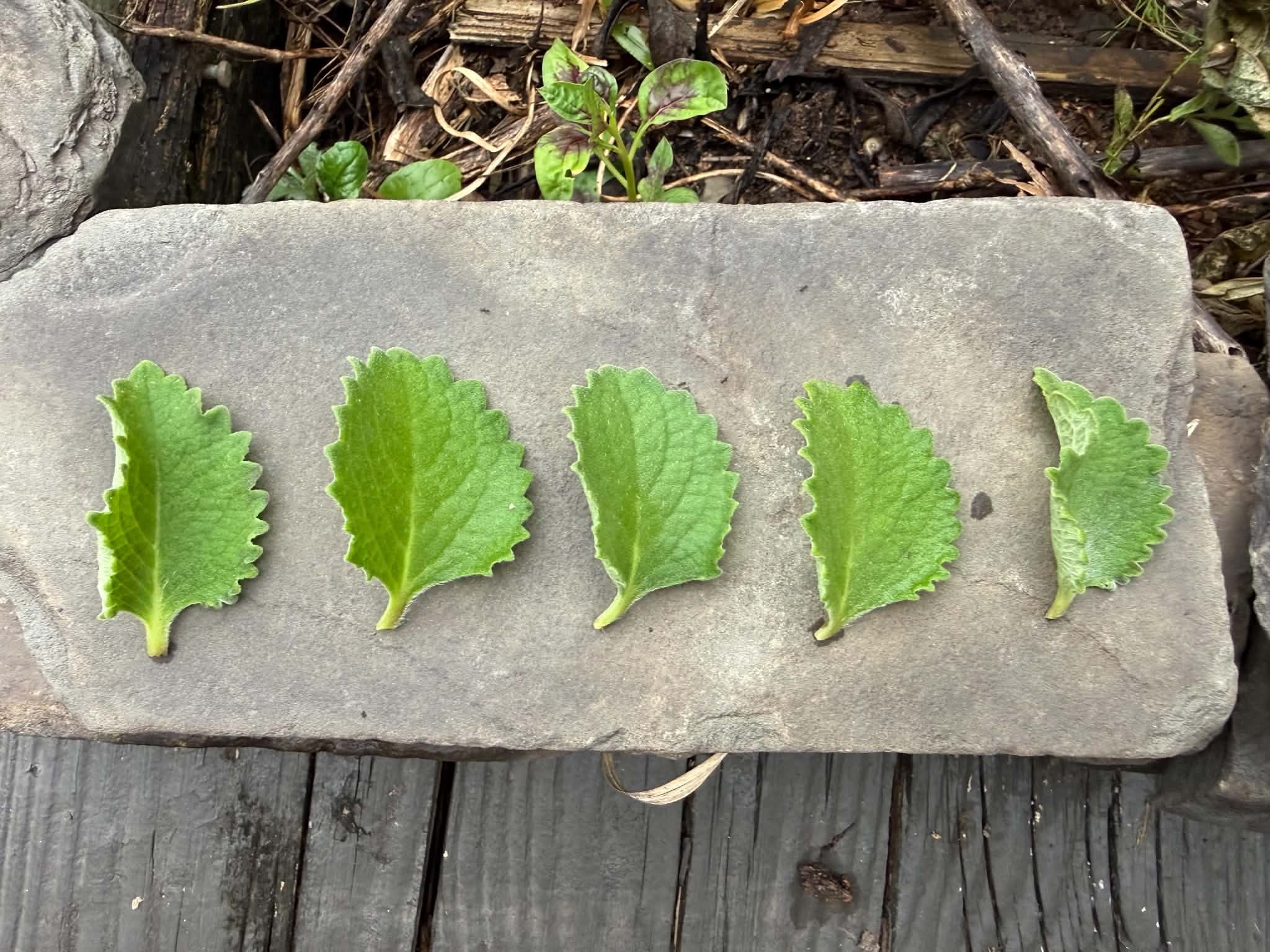
But it doesn't necessarily tell us why. Remember we now know the mechanism by which Torbangun can increase prolactin receptor concentration, but it’s all these variables that can interfere with that process. In the spirit of my university lecture days, here’s me drawing a diagram of exactly what I’m describing:
How Boob Food Too measures up
Obviously, I have a horse in this race. I make this stuff..
But here's something I've always found genuinely interesting about Boob Food Too: the reviews are ridiculously consistent.
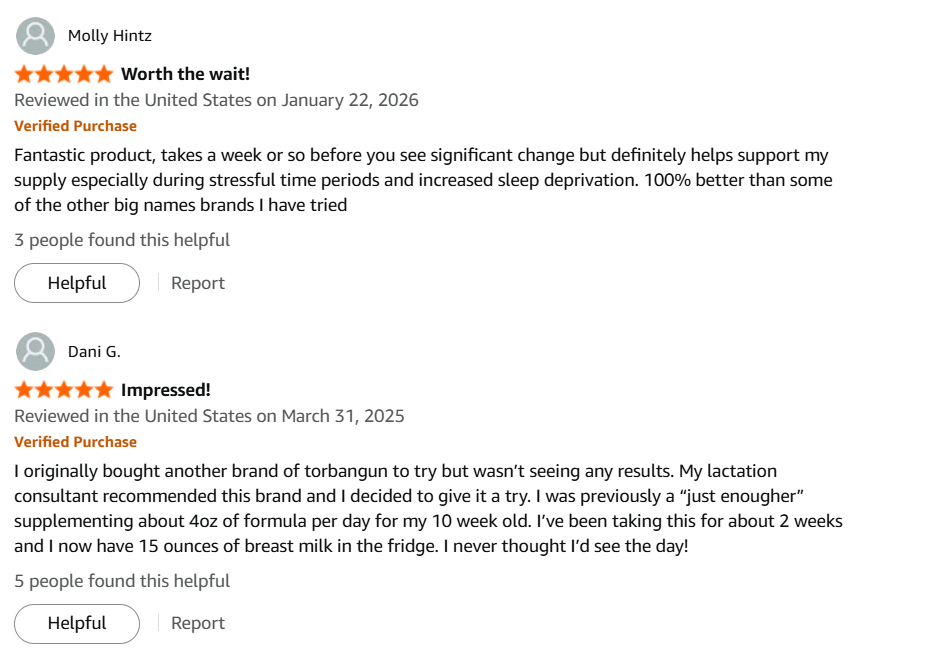
A couple of our favorite reviews on Amazon
Most bottles we’ve sold have been directly on Elk Haven Herbals and people have found their way to us simply by the exceptional word-of-mouth reviews they hear. I’m still bamboozled that we sell bottles every day directly on our website because of some abstract real life mom-to-mom conversation algorithm. That’s the undeniable 5 star review in my opinion. Since selling on Amazon our reviews mirrored the real life recommendations that have existed all along. The review history is quite simply striking. I've watched our product accumulate overwhelmingly positive reviews without the usual pile of one, two, and three-star reviews you eventually see once a product has been around for a while.
That's not something I engineered. It's just what happened. And the reviews aren't simply "good product, five stars." Women talk about seeing increases in their supply. They talk about noticing a difference quickly. They talk about coming back and buying it again. And then there's another thing I see over and over:
They like what isn't in it.
Boob Food Too is deliberately boring.
It's 100% torbangun and distilled water. No fenugreek. No proprietary blend. No glycerin. No preservatives. We actually grow the torbangun ourselves and make the extract from fresh plants. Because we're not trying to make it shelf-stable with preservatives, it has to be refrigerated (don’t worry it’s absolutely fine for a few days during shipment).
The beauty of Boob Food Too is its simplicity. And apparently there are quite a few women who find that reassuring.
Our Etsy reviews are less compared with Amazon, but the pattern is the same. The current listing is 5 stars with 100% of buyers recommending it. One customer said she noticed an increase in her supply after about a week and immediately ordered a second bottle. Another said the product had been recommended by a physician.
That's pretty damn gratifying after spending almost 15 years properly propagating and extracting this plant.
Then I started comparing it to other similar lactation supplements
And this is where it gets even more interesting when you look at the broader category. Some of the biggest, most established lactation supplement companies have thousands of reviews and very respectable averages. Four stars, four-and-a-half stars, whatever. But when you actually read through them, you inevitably start seeing the same handful of complaints: didn't work for me, didn't increase my supply, hated the taste, upset my stomach, made the baby fussy, etc.
That's normal. That's what happens when you sell a supplement to a lot of people. Which is why I find our review history so strange. We don't have that.

We don't have thousands of five-star reviews because we're some gigantic supplement company with a massive marketing department. Most of our sales have happened quietly, directly through our website, because one mom told another mom about it.
And then when we finally started accumulating enough Amazon reviews to see a real pattern, the pattern was basically the same thing we'd been hearing through word of mouth for years. That's the part I find hard to dismiss.
I'm not saying it proves Boob Food Too works better than every other lactation supplement. It doesn't. Reviews aren't clinical trials.
But if you're looking at the collective experience of thousands of customers, I think there's something pretty interesting about a product that has been around for more than a decade and somehow hasn't accumulated the usual trail of didn't work, made me sick, tasted terrible, waste of money reviews.
It's actually one of the stranger things about this business. We basically stumbled into a product that moms keep telling other moms about, and apparently that recommendation keeps reproducing itself like some sort of weird biological marketing algorithm.
Does any of this prove Boob Food Too works better?
No. And this is where I think the supplement industry gets itself into trouble. A thousand positive reviews don't constitute a clinical trial. A woman can start taking a supplement at exactly the same time she starts pumping more frequently. Her baby might suddenly become better at transferring milk. She might get more sleep. Her supply might simply be increasing naturally because she's further postpartum.
Then she takes the supplement and her supply goes up. Maybe the supplement caused it. Maybe it helped. Maybe it was one of five things. Maybe it was mostly coincidence. We don't know.
But I also don't think the answer is to dismiss the experiences. There are too many women across too many different products reporting noticeable changes for me to believe the whole category is just nonsense.
Torbangun is particularly interesting to me because it isn't some herb I discovered last Tuesday because it happened to be trending on Instagram. It has a long history of traditional use as a lactation herb, and there is actual research looking at its effects in breastfeeding women.
The weird thing about reading thousands of reviews
You start to realize there probably isn't a best lactation supplement. There are products that seem to work really well for some women and not at all for others. There are complicated blends and simple single-herb products. There are products with thousands of reviews and products with a few dozen. There are women who swear by something and women who couldn't tell they took anything at all.

And then there are the women who are pumping at 2 a.m., staring at three ounces of milk in a bottle and wondering what the heck they're doing wrong. This is the part I wish the supplement industry talked about more. A lactation supplement isn't a substitute for figuring out why supply is low in the first place. If milk isn't being removed effectively, a bottle of herbs isn't going to magically fix that. Sometimes the answer is an IBCLC. Sometimes it's a feeding issue. Sometimes it's pumping technique. Sometimes there's an underlying medical problem.
And sometimes you do all of that right and still don't make as much milk as you wanted.
So if you want to try a galactagogue, I'd treat it like an experiment.
Try it for a few weeks. Pay attention to what happens. And if it doesn't do anything, stop taking it. You don't get extra points for finishing the bottle.
As for me, I'm still growing torbangun almost 15 years later. I can honestly say that helping nursing moms has been a 5-star experience. The business side I’d rate a 3/5 at best though :)
-Aaron